


U.S. News just dropped their 2026-2027 Best Places to Live in Florida rankings.
And two Polk County cities landed above Orlando.
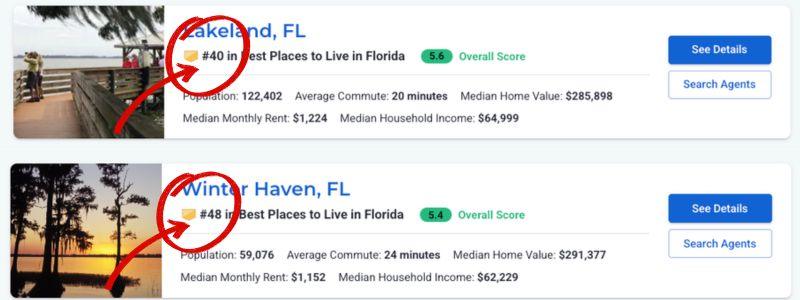
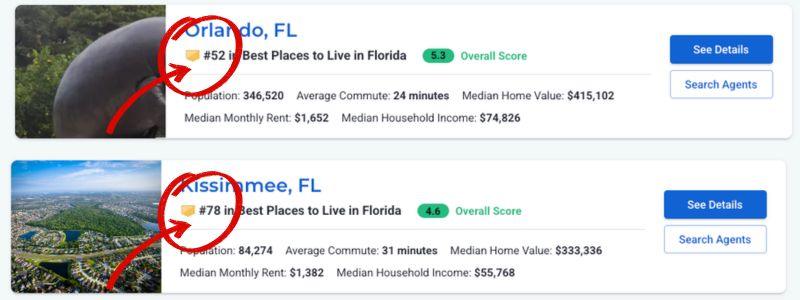
Lakeland came in at #40. Winter Haven came in at #48. Orlando? #52.
And Kissimmee, another popular Central Florida option that people compare to Polk County all the time, came in at #78.
That's out of 81 Florida cities ranked.
Now look, before anyone goes too crazy with this, let's be real. #40 and #48 are middle of the pack. Nobody's putting that on a bumper sticker.
But the data behind those rankings tells a story that anyone living in Polk County (or thinking about moving here) should be paying attention to.
Here's what we're going to break down:
- How The Rankings Actually Work
- The Cost Of Living Comparison
- Why Polk Didn't Rank Higher
- Why Clermont Ranked So Much Higher Than Us
- What Would Actually Move Polk County Up
Let's get into it.
How U.S. News Ranks the Best Places to Live in Florida
U.S. News scores cities across five major categories: quality of life, value, desirability, job market, and net migration.
Here's what those actually mean:
- Quality of life includes education, healthcare, air quality, and infrastructure.
- Value covers housing affordability and cost of living.
- Desirability factors in crime rates, weather, culture, and leisure activities.
- Job market looks at employment and income data.
- Net migration measures whether people are moving in or out.
Each city gets an overall score out of 10.
Lakeland scored a 5.6. Winter Haven scored a 5.4. Orlando scored a 5.3. Kissimmee scored a 4.6.
The margins between Lakeland, Winter Haven, and Orlando are thin. We're talking fractions of a point.
But the comparisons underneath those scores are where things get interesting.

Lakeland & Winter Haven vs. Orlando: Cost of Living Comparison
This is where Polk County separates itself. And it's not close.
Home Values
The median home in Lakeland costs $285,898. In Orlando, it's $415,102.
That's a $129,000 difference.
Winter Haven's median home value of $291,377 is also well below Kissimmee's $333,336. That's a $42,000 gap.
Rent
Lakeland's median monthly rent is $1,224 compared to Orlando's $1,652. That works out to $5,136 per year in savings.
Winter Haven's median rent of $1,152 versus Kissimmee's $1,382 means $2,760 per year back in your pocket.
Commute Times
Lakeland's average commute is 20 minutes. Orlando's is 24 minutes.
But the bigger contrast is Winter Haven at 24 minutes versus Kissimmee at 31 minutes. That's 7 fewer minutes each way, every day. Over a year of commuting, that adds up to roughly 60 extra hours of your life.
So Polk County cities are significantly more affordable, have shorter commutes, and STILL managed to score higher than Orlando and Kissimmee on an overall quality-of-life index.
That's not nothing.
Why Lakeland and Winter Haven Didn't Rank Higher
Okay so if affordability and commute times are this strong, why are Lakeland and Winter Haven sitting at #40 and #48 instead of the top 20?
The short answer: the things Polk County is weaker on matter a LOT in these rankings.
Crime rates are likely the single biggest factor holding both cities back. Both Lakeland and Winter Haven have crime rates above the state average, and the ranking's desirability and quality of life indexes weight public safety heavily.
Dining, culture, and entertainment. The "things to do" gap is real. Polk County doesn't have major sports teams, a large-scale arts district, or the depth of nightlife and entertainment options that cities like Tampa, Orlando, or even Pensacola offer. The desirability category measures this, and Polk can't compete with metros on cultural infrastructure.
Not yet, anyway.
Household incomes and the job market are another drag. Lakeland's median household income is $64,999. Winter Haven's is $62,229. Compare that to Clermont, a city that ranked #17 on this same list, at $88,691. There's no major employer cluster or industry hub in Polk County pulling wages up. A lot of the workforce commutes to Tampa or Orlando for work, which means Polk's job market index suffers even as its residents contribute to the economies of neighboring counties.
Healthcare and infrastructure round out the quality-of-life metrics, and as a fast-growing area, Polk is still building the capacity to match its population growth.
Why Clermont Ranked #17 (and What That Tells Us About Polk County)
This is worth addressing because Clermont at #17 and Lakeland at #40 is a 23-spot gap for two cities in the same general region of Central Florida.
So what's going on there?
Clermont functions as an Orlando suburb. It sits in Lake County on the western edge of the Orlando metro area, so its residents get access to Orlando's job market, Orlando's cultural amenities, and Orlando's entertainment infrastructure... but with suburban crime rates, newer schools, newer-build housing, and a more affluent population base.
Clermont essentially borrows Orlando's desirability and job market scores while keeping its own value and quality-of-life advantages as a smaller, newer community. It gets the upside without the downsides that drag Orlando itself down to #52.
Lakeland and Winter Haven are different. They're freestanding cities with their own independent economies, their own identities, and their own challenges. They don't get to borrow Tampa's or Orlando's cultural infrastructure in the rankings the way Clermont borrows Orlando's.
That independence is arguably what makes them interesting (and what makes covering them worthwhile), but it's exactly what these rankings penalize.

What Would Move Polk County Higher in Future Rankings?
If you look at the methodology and where Polk loses ground, there are four areas that would actually shift the needle:
1. Lower crime rates. This is probably the single highest-impact change. Public safety shows up in multiple categories of the ranking. Progress here would move the scores more than almost anything else.
2. More dining, culture, and entertainment. The "things to do" gap is real, but it's also closing. New restaurants, breweries, coffee shops, and entertainment venues are opening across Polk County regularly. Every new spot that opens is one more data point in the desirability column. This is a category that improves gradually, and it's already trending the right direction.
3. Higher-paying local jobs. Median incomes of $62-65K lag behind cities like Clermont ($89K) significantly. Attracting more employers who pay competitive wages, and keeping skilled workers working locally instead of commuting out of the county, would improve the job market index. Economic development efforts are actively working on this.
4. Healthcare and infrastructure investment. As population grows, quality of life metrics need the hospitals, schools, roads, and public services to keep pace. Investment in these areas tends to follow population growth, but the rankings measure the current state, not the trajectory.
Is Polk County a Good Place to Live in 2026?
Polk County cities already outrank Orlando and Kissimmee on a national quality-of-life index. Even with clear room to grow.
The cost-of-living advantage isn't small. We're talking $129,000 cheaper homes, $5,000 per year less in rent, and shorter commutes.
And the areas where Polk falls short (dining, culture, entertainment, local employment) are the areas that are actively changing. New businesses are opening. The population is growing. The community is building itself.
Rankings like these are a snapshot. They measure where a place has been, not where it's going.
And if you're paying attention to what's happening on the ground in Polk County, the trajectory is clear.
This is a county on the way up.
 Never Miss An Event Or Story